
- Home
- /
- Treatments
- / Muse Stem Cells

The One Stem Cell Rare Enough to Reach Every Tissue in Your Body — and Why Most Clinics Don't Use It
Most stem cell clinics offer mesenchymal stem cells. Muse cells are a rare subset inside that population — about 1 to 5 percent of it — and they behave differently enough that the distinction changes what you should be asking your provider.
This page explains the difference in plain language. No pressure, no promises. When you’ve read it, our medical team will tell you honestly whether the evidence supports a regenerative approach in your situation.
Dezawa MuseCells® program
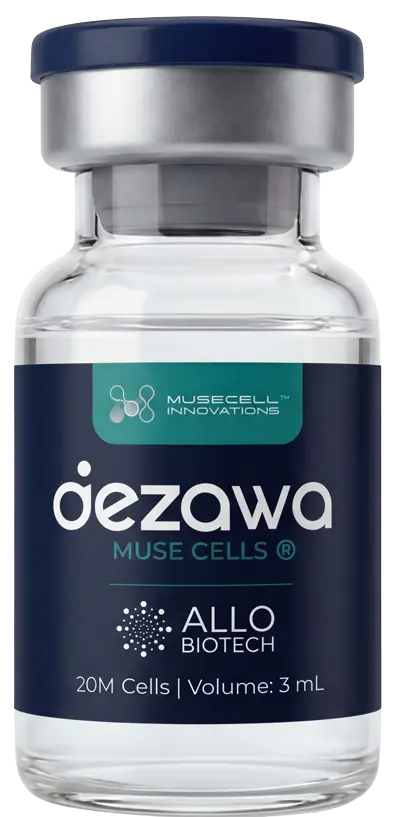
The short answer: Muse cells — short for Multilineage-differentiating Stress-Enduring cells — are a rare population of repair cells found in adult human tissue, identified by the surface marker SSEA-3. Published research describes them as pluripotent-like: able to become cells of all three germ layers, able to travel to injured tissue on their own, and — unlike other pluripotent cells — never observed forming tumours. They were discovered in 2010 by Dr. Mari Dezawa at Tohoku University in Japan.
What is a Muse cell?
Muse cells already exist inside you. They sit in your bone marrow, your bloodstream, your fat and skin, and the connective tissue of your organs. They are part of how your body repairs itself.
They were found by accident. In 2003, a technician in Dr. Dezawa’s laboratory was culturing mesenchymal stem cells that had been subjected to severe stress, and asked whether the ruined batch should be thrown out. Most researchers would have said yes. Dezawa looked closer and saw that a small number of cells had survived conditions that killed everything around them.
That survival trait gave them their name — Stress-Enduring — and it turned out to be the least interesting thing about them.
What "multilineage-differentiating" means for you
Most adult stem cells are multipotent: they can become a limited menu of cell types, usually within one tissue family. Muse cells are described in published studies as pluripotent-like, meaning they have differentiated into cells from all three embryonic germ layers:
- Ectoderm — nerve and skin lineages
- Mesoderm — muscle, bone, cartilage, cardiac lineages
- Endoderm — liver and internal organ lineages
That breadth is normally the exclusive territory of embryonic stem cells and lab-reprogrammed iPSCs — both of which carry tumour risk. Muse cells reach it without reprogramming, and without that risk appearing in the literature.
How do Muse cells actually work?
Three steps. Understanding them is the fastest way to see why the Muse-versus-MSC distinction matters.
They survive the environment they're sent into
Damaged tissue is hostile — low oxygen, inflammation, metabolic stress. A therapeutic cell that dies on arrival accomplishes nothing. Stress endurance isn’t a bonus feature here; it’s the precondition for everything else.
They navigate to the injury themselves
Injured cells release a lipid signal called sphingosine-1-phosphate (S1P), strongest at the damage and weaker further out. Muse cells carry S1P receptors, read that gradient, and migrate toward the source. This is why the Japanese clinical trials used a simple IV infusion for conditions as different as stroke and heart attack — the cells were expected to find the target on their own.
They repair two ways, not one
Like MSCs, they release growth factors, cytokines and exosomes that calm inflammation and stimulate surrounding tissue. Unlike MSCs, published studies also show them differentiating and integrating into the damaged tissue itself.
How Muse cell therapy is given — and what it's used for
The delivery method depends on where the problem is. A localized joint issue is treated differently than a condition driven by inflammation running through the whole body — and Muse cells are given both ways.
Local injection — for a specific site
Cells are injected directly into the affected joint or tissue — knee, hip, shoulder, spine — for targeted pain relief, tissue regeneration, and restoration after injury or degeneration. This is a direct, in-office procedure with no systemic exposure.
IV infusion — for systemic conditions
Given intravenously, cells travel through the bloodstream and use their own S1P-receptor homing ability to find sites of inflammation and injury throughout the body. This route is used for systemic inflammatory, autoimmune, and neurological applications.
Conditions and applications
Below is where each route is typically applied. Every case is different — your consultation is where we determine whether the evidence supports treatment for your specific condition.
Joint & musculoskeletal (local)
Knee, hip, shoulder, and spine pain; cartilage wear and soft-tissue injury; post-injury tissue regeneration and restoration.
Autoimmune & inflammatory (systemic IV)
Rheumatoid arthritis, lupus, Crohn’s disease, and other conditions driven by chronic systemic inflammation.
Neurological (systemic IV)
Multiple sclerosis and post-stroke recovery — conditions where Muse cells’ ability to home to damaged tissue is central to the published research.
General systemic inflammation (IV)
Broader inflammatory burden not isolated to a single joint or organ, where a whole-body approach is more appropriate than a local injection.
Not every condition on this page is right for every patient. Bring your history and any prior imaging or labs to your consultation, and we’ll walk through what the evidence actually supports for you — local, systemic, or neither.
Muse cells vs. mesenchymal stem cells (MSCs)
Here’s the part almost no clinic explains properly: Muse cells are not an alternative to MSCs. They are a rare subset found within them.
Which cuts both ways. It means nearly every MSC product technically contains some Muse cells — and it means “contains Muse cells” and “is an enriched, verified Muse cell product” are completely different claims. Roughly 1 to 5 percent of a standard MSC preparation is SSEA-3 positive. The rest works by a different mechanism.
| Property | Mesenchymal Stem Cells | Muse Cells |
|---|---|---|
| Relationship | The bulk population | ~1–5% subset inside it |
| Potency | Multipotent | Pluripotent-like |
| Identified by | CD73, CD90, CD105 | SSEA-3 |
| Germ layers reached | Mainly mesoderm | All three |
| How they repair | Signalling only | Signalling + tissue integration |
| Finding the injury | Limited, non-specific | Directed, via S1P receptors |
| Stress tolerance | Standard | Survives severe stress |
| Genetic reprogramming | None needed | None needed |
| Tumour formation | Not reported | Not reported |
| Donor matching | Often considered | Trials ran without HLA matching |
| Manufacturing | Simpler — bulk culture | Complex — requires enrichment |
Swipe the table sideways on mobile to see all columns.
And how do they compare to embryonic stem cells or iPSCs?
Pluripotency almost always comes with a catch. Embryonic stem cells carry teratoma risk and ethical objections. iPSCs must be genetically reprogrammed, which adds risk and manufacturing complexity. Muse cells require neither — the pluripotent-like behaviour is native to the cell, not induced. That combination is the reason researchers took them seriously.
Not sure whether you’d be receiving MSCs or genuinely enriched Muse cells? That’s the right question, and it’s the first thing we’ll clear up. Bring us any quote you’ve received and we’ll read it with you.
Are Muse cells safe? Do they cause tumours?
No tumour or teratoma formation has been reported across published Muse cell studies, and human trials administered donor cells without HLA-matching tests and without immunosuppressant drugs. That is a strong early safety record — built on small cohorts with limited long-term follow-up.
Both halves of that are true at once, and you deserve both.
Why the tumour question matters
Pluripotency and tumour risk are usually linked. Embryonic stem cells and iPSCs can form teratomas precisely because they retain the ability to become anything. It has been the main obstacle to using pluripotent cells clinically.
Muse cells appear to avoid it for two reasons: they aren’t genetically reprogrammed, and they seem to lack the runaway proliferative capacity that drives teratoma formation. This is why the literature says pluripotent-like rather than pluripotent. That word is doing real work.
The immune finding
Across Japanese trials, donor-derived Muse cells were given without HLA matching and without immunosuppressants. In conventional donor cell therapy, both omissions would be expected to cause problems. They didn’t. Avoiding immunosuppression matters — those drugs carry real risks of their own, including infection.
What we don't know yet
- Published trials involved small numbers of patients. Rare adverse events are invisible at that scale.
- Long-term, multi-year safety data in large populations doesn't exist yet.
- No Phase 3 trials have been completed — that's where uncommon signals usually surface.
- Safety findings describe the specific products studied and don't automatically transfer to other preparations.
In practice, the biggest safety variable usually isn’t the cell type at all. It’s the manufacturing and the provider — unregistered facilities, uncharacterised products, no Certificate of Analysis, no verification the cells are even alive on arrival.
Ask us for our documentation. Certificate of Analysis, facility registration, post-thaw viability. We’d consider it a good sign if you did — and we’d tell you to ask any other clinic the same.
What the human research actually found
Human trials have been run in Japan using an allogeneic Muse cell product, covering heart attack, ischemic stroke, ALS, epidermolysis bullosa, spinal cord injury and neonatal brain injury. We’d rather you hear the results from us than from a page selling you something.
In subacute ischemic stroke, a randomised placebo-controlled trial reported a 40% responder rate versus 10% for placebo at 12 weeks. Encouraging — and a small trial with wide confidence intervals. It’s a signal worth pursuing, not proof.
In ALS, a five-patient Phase 2 trial found the treatment well tolerated across six monthly infusions, but the functional outcome measure did not reach statistical significance. Any clinic citing that study as evidence Muse cells help ALS is misrepresenting it.
There are no completed Phase 3 trials, and no published human trials for anti-ageing, longevity or cosmetic use despite heavy marketing in those categories.
What does Muse cell therapy cost?
Our authenticated Dezawa MuseCells® programs start at $16,900. Across the industry, publicly advertised pricing ranges from around $3,000 to over $50,000 — offshore programmes in Mexico, Japan and the Caribbean have historically quoted $25,000–$50,000 on the high end, and the $3,000 end is usually a diluted or unverified product, not an enriched Muse cell preparation. That spread is mostly not about quality of care.
What actually drives it:
Enrichment
Isolating a rare SSEA-3 subset under cleanroom conditions costs far more than culturing bulk MSCs. This is the legitimate part of any price gap.
Dose and infusions
A “$5,000” price that turns out to be per-infusion in a three-infusion protocol is a $15,000 programme. Always ask for total cost.
What's bundled
Labs, imaging, physician time and follow-up may or may not be included. This is where quote-to-invoice surprises come from.
Insurance
Essentially never covered. Muse cell therapy is not FDA approved, and insurers don’t cover investigational cell therapies. Expect to pay out of pocket.
One thing worth saying out loud: if a clinic won’t discuss any pricing until you’re sitting in a room, they’re managing your commitment rather than your care. And time-limited discounts have no place in a medical decision.
We’ll have the evidence conversation before the money conversation. If the research doesn’t support treatment in your case, we’ll say so — and that consultation still costs you nothing.
Is Muse cell therapy FDA approved?
No. As of 2026 there is no FDA-approved Muse cell product for any indication in the United States. Anyone telling you otherwise is misinforming you.
Florida is one of the few states with a defined framework. SB 1768, effective July 1, 2025, permits licensed Florida MDs and DOs to administer certain non-FDA-approved stem cell therapies — only for orthopedics, wound care and pain management, and only when the cells come from an FDA-registered facility accredited by the NMDP, WMDA, AABB or AATB, with documented informed consent and a post-thaw viability report.
Two things that framework does not do: it does not cover neurological, autoimmune, cardiac or anti-ageing indications, and it does not override federal law. State authorisation is not FDA approval.
If you see a Florida clinic advertising Muse cell therapy for stroke recovery, autism or longevity, they’re marketing outside what the statute permits. That’s worth knowing whoever you choose.
Authentic Muse cells vs. "Muse-like"
Muse research is public, which means anyone can cite it. A clinic can reference the Japanese trials while administering a product made by an entirely different method, from a different source, with no verification the SSEA-3 fraction was ever enriched. Nothing in the citation is false. The implication is.
Miami Stem Cell is an authorized provider of Dezawa MuseCells®, licensed through MuseCell Innovations®, the exclusive global licensor of the intellectual property developed by Professor Mari Dezawa’s department at Tohoku University. Practically, that means the product traces back to the licensed manufacturing ecosystem the published research describes, and every lot carries a Certificate of Analysis.
Named manufacturer
Not “a leading laboratory.” A name you can verify.
FDA-registered facility
Registration under 21 CFR Part 1271 is mandatory. Absence is disqualifying.
Lot-specific COA
Cell count, viability, sterility, verified SSEA-3 percentage — for your vial.
Post-thaw viability
Frozen cells lose viability on thaw. A product of dead cells does nothing.
Ask every provider for all four. Including us.
What happens at your free consultation
It’s a conversation, not a sales appointment. Roughly 30–45 minutes, in person or by telehealth.
We listen first
Your history, what you’ve already tried, what you’re hoping for, and what you’ve been told elsewhere.
We separate evidence from marketing
What the published research supports for your situation — and specifically what it doesn’t. If a different therapy fits better, we’ll point you toward our full range of regenerative treatments instead.
We show you the paperwork
Sourcing, manufacturing, Certificate of Analysis. Ask us anything about it.
You leave with a straight answer
Including “this isn’t appropriate for you,” if that’s the honest answer. We’d rather tell you that than take your money.
No cost. No obligation. No pressure to decide on the day.
Muse stem cell questions
What are Muse cells in simple terms?
Muse cells are rare repair cells that already exist in your body. They survive extreme stress, can become many different cell types, and travel to injured tissue when they detect its chemical distress signals. The name stands for Multilineage-differentiating Stress-Enduring.
What's the difference between Muse cells and mesenchymal stem cells?
Muse cells are a rare subset found within mesenchymal stem cell populations — roughly 1 to 5 percent — identified by the SSEA-3 marker. MSCs are multipotent and work mainly by signalling. Muse cells are described as pluripotent-like, reach all three germ layers, home to injury via S1P receptors, and both signal and integrate into tissue.
Are Muse cells better than regular stem cells?
No head-to-head human trial has shown Muse cell preparations produce better outcomes than standard MSC therapy for any condition. Muse cells have distinct mechanistic advantages, but a better mechanism is not the same as proven better results, and we won’t tell you otherwise.
Do Muse cells cause tumours?
No teratoma or tumour formation has been reported in published Muse cell studies. This distinguishes them from embryonic stem cells and iPSCs, which can form teratomas.
How are Muse cells given?
In published clinical trials, by intravenous infusion — thawed, diluted, and infused over roughly 10 to 15 minutes. No surgery and no anaesthesia. Because the cells home to injury via S1P signalling, direct injection into the target organ wasn’t required.
Is Muse cell therapy FDA approved?
No. As of 2026, no Muse cell product has FDA approval for any indication in the United States. Florida SB 1768 permits licensed physicians to administer certain non-approved stem cell therapies for orthopedics, wound care and pain management, but state authorisation is not FDA approval.
How much does Muse cell therapy cost?
Our authenticated Dezawa MuseCells® programs start at $16,900. Industry-wide, publicly advertised pricing runs from roughly $3,000 to over $50,000, depending on cell source, enrichment, dose, number of infusions and what’s bundled. Insurance does not cover it. We’ll discuss whether treatment is appropriate before discussing cost.
What conditions can Muse cell therapy be used for?
Locally injected into a joint, Muse cells are used for targeted pain relief and tissue regeneration — knee, hip, shoulder, and spine. Given by IV, they’re used for systemic and inflammatory conditions including rheumatoid arthritis, lupus, Crohn’s disease, multiple sclerosis, and post-stroke recovery, since the cells home to inflammation and injury throughout the body. Suitability depends on your individual case and is determined during your consultation.
What's the difference between local injection and IV Muse cell therapy?
Local injection places cells directly into a specific joint or tissue for targeted repair, with no systemic exposure — used for musculoskeletal pain and regeneration. IV infusion delivers cells into the bloodstream, where their S1P-receptor homing ability lets them travel to inflammation or injury anywhere in the body — used for systemic, autoimmune, and neurological conditions.
Is it spelled Dezawa, Dazawa or Desawa?
The correct spelling is Dezawa — Dr. Mari Dezawa of Tohoku University Graduate School of Medicine, who identified Muse cells in 2010. Dazawa and Desawa are common phonetic misspellings from hearing the name spoken. All refer to the same researcher.
Where can I get Muse stem cell therapy near me in Miami?
Miami Stem Cell is located at 6262 Sunset Drive, Suite 400, South Miami, Florida, and is an authorized provider of Dezawa MuseCells®. Call 305.598.7777 or book a free consultation online.
Is the consultation really free?
Yes — free, with no obligation. Its purpose is to establish whether the published evidence supports a regenerative approach for you, including the possibility that it doesn’t.
Get a straight answer — free
Thirty minutes with our medical team, no cost and no obligation, to find out whether the evidence supports a regenerative approach in your situation.
Medical disclaimer. This page is educational and is not medical advice. Muse cell products are investigational and are not approved by the U.S. Food and Drug Administration to treat, cure or mitigate any disease. Descriptions of published research report study findings and are not claims that Miami Stem Cell treats any condition. Individual results vary. Consult a licensed physician, and consult your primary care provider before undergoing any stem cell therapy.
Trademarks. Dezawa MuseCells®, Dezawa MuseExosomes® and MuseCell Innovations® are marks of MuseCell Innovations® PTE LTD, Singapore. Only products originating from MCI’s licensed manufacturing ecosystem and distributed through MCI-designated partners carry the characteristics reported in that research.
Separate programmes. CL2020 is a distinct investigational Muse cell product developed by Life Science Institute, Inc. for clinical trials conducted in Japan. It is a separate programme and is not offered by Miami Stem Cell.