

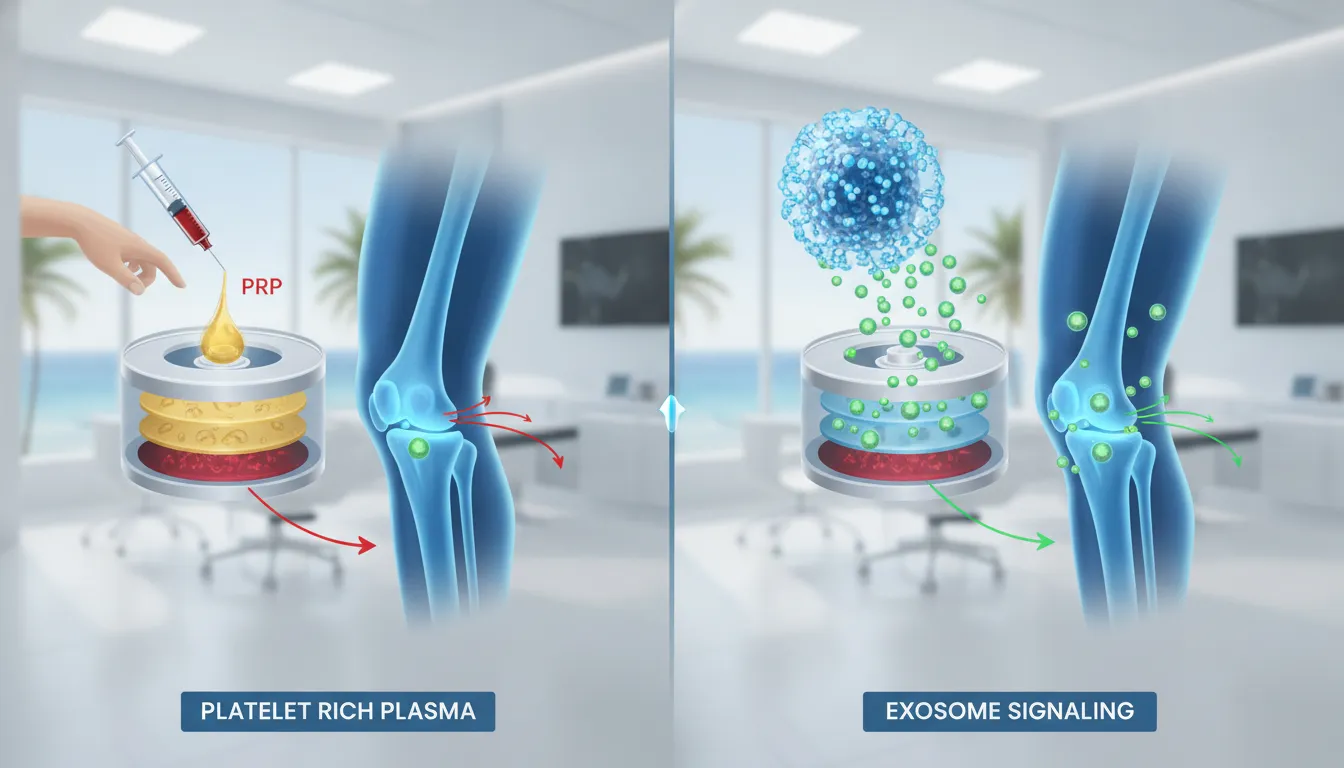
PRP and exosomes may both be discussed for painful knees, hips, shoulders, or other joints, but they are not the same treatment. PRP vs exosomes for joint pain is really a comparison between concentrated platelets from your own blood and externally sourced cell-signaling particles. The right option depends on the joint problem, the level of damage, recovery goals, safety considerations, and the physician’s assessment.
PRP uses a patient’s own blood to concentrate platelets and growth factors, while exosomes are tiny extracellular vesicles that carry biologic signals between cells. PRP is often considered for tendon, ligament, and joint concerns where a patient’s own healing response is useful. Exosome-based options focus more on cell communication and inflammation signaling, with evidence still developing.
For Miami patients, the smartest question is not which option sounds newer or stronger. It is which option fits the diagnosis and the person. This guide explains the differences, compares practical factors, and shows what to ask before choosing a regenerative joint treatment.
PRP vs exosomes for joint pain: the core difference
PRP vs exosomes for joint pain starts with source. PRP is autologous, meaning it comes from your own blood. Exosome products are not platelets and are not whole stem cells. They are small vesicles that may carry proteins, lipids, RNA, and other signals involved in cell-to-cell communication.
What PRP contains
PRP stands for platelet-rich plasma. A clinician draws blood, processes it, and prepares a platelet-concentrated portion for injection near the affected joint or surrounding tissue. The Mayo Clinic describes PRP as a concentration of a patient’s own platelets used to accelerate healing in injured tendons, ligaments, muscles, and joints.
In plain terms, PRP delivers more platelet-derived growth factors to a targeted area. It does not create new cartilage on command, and it is not a guaranteed alternative to surgery. Miami Stem Cell’s PRP therapy overview frames it as one option within a personalized, non-surgical regenerative plan.
What exosomes contain
Exosomes are extracellular vesicles. They are much smaller than cells and can carry biologic messages that influence how cells respond to their environment. A peer-reviewed review of exosome biology describes their role in moving bioactive molecules between cells.
For joint care, exosome-based discussions usually focus on inflammation signaling, tissue environment, and repair-related communication. The science is active but still evolving. Patients should ask what product is being considered, where it comes from, how it is handled, and what evidence supports its use for their specific joint condition.
Why source changes the decision
The source affects comfort level, regulatory questions, cost, and clinical reasoning. PRP begins with your own blood, so the treatment is built around your biology. Exosome products depend on sourcing, processing, and quality controls. Neither path should be presented as a cure. Both require a medical evaluation and realistic goals.
How do PRP and exosomes compare side by side?
PRP and exosomes can both fit regenerative joint care, but they differ in material, mechanism, preparation, evidence maturity, and cost. A comparison table helps patients see why a physician might recommend one option, discuss both, or advise a different path based on imaging and exam findings.
| Factor | PRP | Exosome-based option |
|---|---|---|
| Primary source. | Patient’s own blood. | Extracellular vesicles from a biologic source. |
| Main material. | Concentrated platelets and growth factors. | Cell-signaling vesicles and bioactive cargo. |
| Typical clinical idea. | Support a local healing response. | Support communication related to inflammation and repair. |
| Evidence maturity. | More familiar in orthopedic and sports medicine settings. | Promising but still developing for many joint uses. |
| Practical considerations. | Requires blood draw and processing during the visit. | Requires careful product sourcing, storage, and handling. |
| Cost considerations. | Often tied to preparation, joint treated, and guidance used. | Often influenced by product sourcing and biologic handling. |
Reading the comparison
The table is not a ranking system. It is a decision framework. PRP may make sense when a physician wants to use concentrated platelets from the patient’s own body. Exosome-based options may be discussed when cell-signaling support is part of the clinical rationale. The best choice depends on the joint, not the marketing label.
This is also where expectations matter. Some patients want less pain with daily activities. Others want to return to sport, delay surgery, or reduce reliance on repeat steroid injections. Those goals can lead to different recommendations. Miami Stem Cell’s joint regeneration resources explain how regenerative planning can be tailored to orthopedic concerns.
When might a physician recommend PRP or exosomes?
A physician may consider PRP or exosomes after reviewing the diagnosis, imaging, pain pattern, prior treatments, age, activity demands, and overall health. The recommendation should start with what is driving the pain, then match the biologic option to the most realistic treatment goal.
What is driving the joint pain?
Joint pain can come from cartilage wear, tendon irritation, ligament injury, inflammation, biomechanics, old trauma, or multiple issues at once. A painful knee with early arthritis is not the same as a shoulder tendon problem or severe bone-on-bone degeneration. That difference matters before any injection is selected.
PRP is often discussed when platelet-derived growth factors may support a local healing response. Exosome-based options may be discussed when the clinician is focusing on signals in the tissue environment. If the pain is primarily mechanical because the joint is unstable or severely degenerated, an injection alone may not be enough.
Severity, inflammation, and tissue quality
Severity changes the conversation. Mild to moderate degeneration may leave more room for a non-surgical regenerative strategy. Advanced joint collapse, severe instability, or major structural damage may require a different plan. A responsible physician will explain when biologic injections are reasonable and when expectations should be limited.
Inflammation also matters. Some patients have swelling and irritated tissue. Others have chronic pain with less visible inflammation. Exosome research for osteoarthritis and cartilage-related problems is growing, including reviews of extracellular vesicles in osteoarthritis, but evidence still needs careful interpretation.
Goals, treatment history, and overall health
A physician should ask what success would look like. Is the goal walking without sharp pain, returning to golf, avoiding or delaying surgery, or reducing flare-ups? Prior steroid injections, physical therapy, medications, surgery history, and medical conditions all influence the plan. The safest recommendation is individualized, not generic.
What should you expect after treatment?
Recovery after PRP or exosome-based joint care is usually planned around the treated joint, the injection approach, and the patient’s baseline condition. Many patients can resume light activity quickly, but soreness, temporary restrictions, and gradual improvement timelines should be discussed before treatment.
The appointment and first few days
With PRP, the visit often includes a blood draw, processing, and injection. With exosome-based care, the preparation process is different because the product is sourced and handled before use. In either case, image guidance, sterile technique, and clear aftercare instructions are important.
Some soreness after an injection can happen. Patients may be advised to avoid strenuous activity for a period of time, depending on the joint and procedure. Follow-up matters because the treatment is part of a plan, not a one-time promise. The plan may include activity modification, rehabilitation, and reassessment.
A gradual and individual response
Regenerative injections are not instant pain relievers in the same way some anti-inflammatory shots may be. PRP is commonly discussed as a way to support healing biology over time. Exosome-based options are also framed around signaling and tissue environment. That means response can be gradual and individual.
Patients should be cautious with any claim that promises a specific outcome by a specific date. A better consultation explains what improvement may be realistic, what would count as a poor response, and when another treatment path should be considered.
Cost considerations for exosome therapy vs PRP
Cost is different for exosome therapy vs PRP because the biologic material and preparation steps differ. PRP cost is often tied to blood processing, injection complexity, and guidance. Exosome-based care may also involve product sourcing, quality controls, handling, and storage considerations.
Why prices can vary
A knee injection is not always priced like a shoulder injection. Image guidance, the number of joints treated, visit complexity, and follow-up needs can affect the final estimate. PRP preparation systems also vary. Exosome products can vary by source, processing, concentration claims, and documentation.
Insurance coverage is another practical issue. Many regenerative treatments are paid out of pocket. Rather than relying on a general internet price, patients should ask for a personalized estimate after the physician understands the condition and explains the treatment plan.
Questions to ask about value
- Confirm the diagnosis. The treatment should match a documented joint problem.
- Ask why this biologic fits. The physician should explain why PRP, exosomes, or another option fits.
- Clarify what is included. Ask about evaluation, imaging review, guidance, product preparation, and follow-up.
- Discuss the limits. A credible plan should include reasons the treatment may not work.
How to choose safely in Miami
Choosing safely means starting with diagnosis, evidence, product quality, and compliance. Miami patients should look for a physician-led process that explains the source of the biologic, the reason it is being used, the risks, the alternatives, and the expected follow-up.
Start with the joint, not the injection
The consultation should begin with the painful joint and the patient’s goals. A clinic should review symptoms, prior care, medical history, and available imaging. If more information is needed, the plan should pause for appropriate evaluation. The injection should not be chosen before the problem is understood.
Miami Stem Cell positions regenerative care as science-backed and personalized. Its broader pain management and stem cell therapy resources emphasize non-surgical planning, medical oversight, and realistic patient education. That patient-centered process is especially important when comparing biologic options.
Ask compliance and safety questions
For exosome-based options, ask about product source, testing, handling, and documentation. For PRP, ask how the blood is processed, whether image guidance is used, and what aftercare is expected. For both, ask about risks, contraindications, and alternatives. A responsible answer should be clear, not dismissive.
Patients with arthritis should also understand where regenerative care fits among conservative care, rehabilitation, medications, injections, and surgical referral. Miami Stem Cell’s arthritis resources can help frame that conversation before a visit.
Frequently Asked Questions
These answers address common questions patients ask when comparing PRP and exosomes for joint pain. They are educational and should not replace a medical consultation, physical exam, imaging review, or personalized recommendation from a qualified physician.
Is exosome therapy stronger than PRP for joint pain?
Not automatically. Exosomes and PRP work from different biologic starting points. PRP delivers concentrated platelets from your own blood. Exosome-based products focus on cell-signaling vesicles. The better option depends on the joint diagnosis, treatment goal, safety review, product quality, and physician recommendation.
When is it too late for PRP for joint pain?
PRP may be less appropriate when joint damage is advanced, the joint is severely unstable, or surgery is clearly the more realistic option. That does not mean every painful joint is too late. A physician needs to review symptoms, imaging, function, and goals before making that judgment.
How long is recovery after PRP or exosome injections?
Recovery varies by joint, injection type, and patient condition. Some patients return to light activity quickly, while others need more restrictions. Soreness can occur after an injection. Your physician should give specific instructions for activity, medications, warning signs, and follow-up.
What affects the cost of PRP versus exosome therapy?
Cost can be affected by the biologic material, preparation, product sourcing, image guidance, number of joints treated, visit complexity, and follow-up plan. Because these details vary, a personalized estimate after evaluation is more useful than a general online price range.
Can PRP and exosomes be used together for joint pain?
Some care plans may discuss combined biologic strategies, but more treatment is not always better. Combination care should only be considered after a physician explains the rationale, safety considerations, evidence limits, cost, and alternatives for the specific joint condition.
Ready to Compare Your Joint Pain Options?
If you are weighing PRP vs exosomes for joint pain, Miami Stem Cell can help you compare the options with a physician-led evaluation. The goal is to understand your diagnosis, explain realistic expectations, and recommend a plan that fits your joint, health history, and goals.