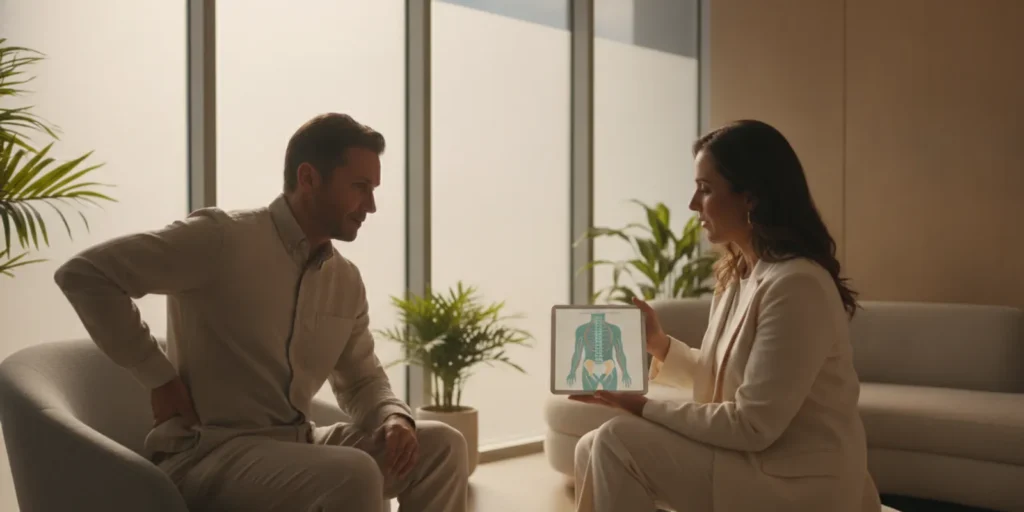
If you are asking what is radiculopathy, the short answer is irritation or compression of a spinal nerve root, which can cause symptoms that travel away from the spine. The pattern depends on which nerve is involved: symptoms may affect an arm or hand, or a buttock or leg. Radiculopathy describes a nerve problem; it does not, by itself, identify the cause or determine the right treatment.
What does radiculopathy mean?
Spinal nerve roots branch from the spinal cord and pass through openings between the bones of the spine. If a root becomes irritated or compressed, pain, tingling, numbness, or weakness can occur along parts of the body supplied by that nerve. When the neck is involved, the term is often cervical radiculopathy. Involvement of a nerve root in the lower back is often called lumbar radiculopathy. Roots in the mid-back can also be affected.
People may say “pinched nerve,” but that phrase does not explain what is causing symptoms. A clinician weighs the location and pattern of symptoms, the examination, and sometimes imaging or other tests. Radiculopathy is different from pain that stays only in the neck or back, although both can occur together.
The University of Kentucky HealthCare overview of radiculopathy describes possible symptoms including muscle weakness in the shoulder, arms, or hands and numbness or tingling in the arms or fingers. Symptoms vary between people, so an online description cannot confirm a diagnosis.
What symptoms can radiculopathy cause?
Symptoms depend on the affected nerve root and the underlying cause. Some people mainly notice pain. Others notice changes in sensation or strength. Symptoms may be felt at a distance from the spine, which can make the source less obvious.
- Pain traveling from the neck into a shoulder, arm, or hand, or from the lower back into a buttock or leg.
- Tingling, “pins and needles,” or numbness in part of an arm, hand, leg, or foot.
- Weakness in muscles supplied by the affected nerve, sometimes noticed as trouble gripping, lifting, or moving normally.
- Symptoms that change with certain positions, movements, or activities.
Not everyone has every symptom. Pain can have causes other than nerve-root irritation, and weakness or numbness should not be self-diagnosed. Keep a brief record of where symptoms begin and travel, how long they last, what makes them better or worse, and whether function is changing. For example, note whether hand tingling occurs only after a certain neck position, or whether leg symptoms appear during walking. These details help a clinician understand the pattern without assuming its cause.
What can cause a nerve root to become irritated?
Several conditions can narrow the space around a nerve root or otherwise irritate it. Examples include a disc bulge or herniation, age-related changes in the spine, and narrowing around the openings where nerves exit. An injury or another spinal condition may also contribute. The likely cause depends on the person and the location.
A finding on an imaging study does not automatically prove that it is the source of someone’s symptoms. A clinician considers whether the location of the finding matches the symptom pattern and examination. This is one reason a scan should not be interpreted in isolation or used to select a treatment without clinical context.
Radiculopathy can affect cervical (neck), thoracic (mid-back), or lumbar (lower-back) roots. The level helps explain where symptoms may appear, but patterns can overlap. Rather than trying to match a symptom to a spinal level yourself, share the whole timeline and pattern with a clinician.
How is radiculopathy evaluated?
An evaluation usually begins with questions: When did symptoms start? Where do they travel? Is there numbness or weakness? What activities are affected? Are symptoms stable, improving, or worsening? A physical examination may assess sensation, strength, reflexes, movement, and other signs. Depending on the situation, a clinician may consider imaging or additional testing. Tests are useful when their results could clarify the diagnosis or guide a care decision.
To prepare, write down the symptoms and when they occur. Bring a list of medicines, relevant health conditions, prior injuries or procedures, and imaging reports you already have. If you have weakness, describe the task it affects: for example, whether you are dropping objects, struggling to raise an arm, or finding a leg less steady. Avoid guessing the diagnosis; a precise account of what you notice is more useful.
For related information, see Miami Stem Cell’s pages on cervical and neck pain and back pain. These pages provide context about the clinic’s focus and do not replace an individualized medical evaluation. A broader overview of the clinic’s pain management information may also help you prepare questions.
How do common care approaches compare?
Care depends on the cause, severity, duration, effect on daily function, and overall health. A plan may begin with monitoring and activity adjustments, guided rehabilitation, or medication discussed with a clinician. Persistent or worsening symptoms, or significant weakness, may call for further assessment. A procedure or surgery is considered only in selected circumstances; radiculopathy does not automatically mean that surgery is needed.
| Approach | What it may involve | Question to discuss |
|---|---|---|
| Observation and activity adjustment | Tracking symptoms and modifying activities that aggravate them, as advised | What changes should prompt reassessment? |
| Rehabilitation | Clinician-guided movement, strengthening, or other therapy tailored to the person | Which activities are appropriate for this diagnosis? |
| Medication | A clinician may discuss medicines based on symptoms and health history | What benefits, risks, and interactions apply to me? |
| Further diagnostic assessment | Imaging or other tests when they may clarify the cause or guide care | How would the result change the plan? |
| Procedure or surgery | Selected options based on diagnosis, severity, and response to other care | What are the alternatives, recovery expectations, and risks? |
This comparison is general information, not a treatment recommendation. Do not stop a prescribed medicine or begin a new exercise plan without discussing it with an appropriate clinician, especially if symptoms include weakness or are changing. Ask what outcome is being monitored and when the plan should be reviewed; this makes it easier to know whether the approach is helping with a meaningful daily activity.
When might regenerative care be part of a discussion?
Some patients exploring non-surgical options ask about regenerative treatments. Whether an option is relevant depends on the diagnosis and individual assessment. It should not be assumed to treat every cause of radiculopathy or to restore a nerve. First clarify what structure is believed to be causing symptoms and whether the proposed care is directed at that problem.
Miami Stem Cell describes its offering as “Non‑Surgical Regenerative Treatments that target the root cause of pain and mobility limitations.” This is a service description, not a promise of outcome. The clinic’s joint and spine regeneration page explains its scope. A discussion should distinguish a general goal from an established expectation for an individual diagnosis, and should include uncertainties as well as potential benefits.
Useful questions include: What condition is the treatment intended to address? What evidence applies to that specific condition? What is uncertain? What alternatives are reasonable, and what happens if I wait or choose another approach? Ask how the clinician will decide whether the treatment is suitable, what risks and follow-up apply, and what outcome would count as meaningful improvement. A consultation can answer questions but cannot guarantee a result or establish candidacy from a webpage.
How can you compare options in a real decision?
It can help to compare options against the same set of priorities rather than focusing only on a treatment name. Consider the diagnosis being addressed, how well that diagnosis is supported, the expected effect on your daily activities, risks and uncertainties, time involved, and the full cost. If a proposed plan does not clearly connect the diagnosis to the treatment, ask for that connection to be explained in plain language.
- Start with the problem. Ask what the clinician believes is causing the symptoms and which findings support that view.
- Define your goal. Identify a practical function you hope to improve, such as sleeping, walking, or using a hand comfortably.
- Compare alternatives. Ask what other reasonable paths exist, including continued observation or another clinical opinion.
- Clarify the follow-up. Ask when progress will be reviewed and what should trigger a change in plan.
- Understand financial details. Miami Stem Cell notes that its treatments are not insurance-billed; confirm current out-of-pocket costs, payment terms, and what follow-up is included before deciding.
These steps help separate a treatment discussion from a treatment decision. You can take time to review information and consult the clinician who manages your spine or nerve symptoms. If you seek a consultation with Miami Stem Cell, ask whether the clinic’s service is within scope for your diagnosis and what information it needs to assess that question.
When should symptoms be assessed promptly?
Seek prompt medical assessment for new or worsening weakness, substantial loss of sensation, or symptoms that are rapidly changing. Sudden severe symptoms, difficulty controlling bladder or bowel function, or numbness around the groin or inner thighs can require urgent evaluation. If you are unsure how urgently to act, contact a medical professional or emergency service for guidance. This article is educational and is not a substitute for medical advice, diagnosis, or treatment.
Frequently asked questions
Is radiculopathy the same as sciatica?
No. Radiculopathy describes dysfunction or irritation involving a spinal nerve root. Sciatica commonly refers to pain traveling along the sciatic nerve distribution, often from the lower back or buttock into the leg. The terms can overlap in some situations, but they are not interchangeable diagnoses. A clinician can assess what is causing a person’s symptoms.
Can radiculopathy occur without back or neck pain?
Yes. A person may notice symptoms in an arm, hand, buttock, or leg even when pain at the spine is not the main complaint. The pattern alone cannot establish the cause, so persistent, significant, or changing symptoms warrant discussion with a clinician.
Does an abnormal scan prove that I have radiculopathy?
Not by itself. Imaging findings need to be considered alongside symptoms and examination. Ask the clinician how a finding matches your experience and whether it changes the recommended next step.
Does radiculopathy always require surgery?
No. The right approach depends on the cause, severity, duration, and effect on function. A clinician can explain what options are suitable for your situation and when reassessment is needed.
Understanding what radiculopathy means can help you describe symptoms and ask focused questions, but the next step should be guided by an individualized assessment of the nerve-root problem and its cause.