
Plantar fasciitis stretches can gently lengthen the sole of the foot and the calf, which may ease stiffness for some people. The goal is a controlled stretch, not sharp pain: begin gently, use a steady routine, and stop if symptoms worsen or new symptoms appear.
What are plantar fasciitis stretches meant to do?
The plantar fascia is a strong band of tissue along the bottom of the foot. It helps support the arch and connects the heel area toward the toes. The calf muscles and Achilles tendon also affect how the ankle and foot move. When the foot is stiff, gentle stretching of the fascia and calf may be one part of a broader plan for managing heel discomfort.
Stretching is not a diagnosis or a guaranteed fix. Heel pain can have more than one cause, and the right approach depends on the person and the source of symptoms. A 2001 rehabilitation review discusses stretching approaches in plantar fasciitis care, while a separate treatment review notes that evidence for stretching and insoles is limited. Those points are a reason to keep expectations measured, not to assume that one exercise works for everyone. Read the rehabilitation review of plantar fasciitis and this evidence-based review of plantar fasciitis treatment for additional context.
Use the exercises below as general education. They do not replace an evaluation from a qualified clinician, especially if pain is severe, persistent, or affecting your ability to walk.
How can you stretch the plantar fascia gently?
A seated plantar fascia stretch gives you control over the amount of pull. Try it when your foot is supported and you can relax your leg.
- Sit in a chair and rest the ankle of the affected foot across the opposite thigh, if this position is comfortable.
- Hold the toes and gently draw them back toward the shin. You may feel a mild stretch along the arch or sole.
- Use your other hand to lightly feel the band along the bottom of the foot. Do not press hard or massage a painful spot aggressively.
- Hold the position for about 15 to 30 seconds while breathing normally, then release slowly.
- Repeat two or three times if the first repetition feels comfortable. Reduce the pull or stop if pain increases.
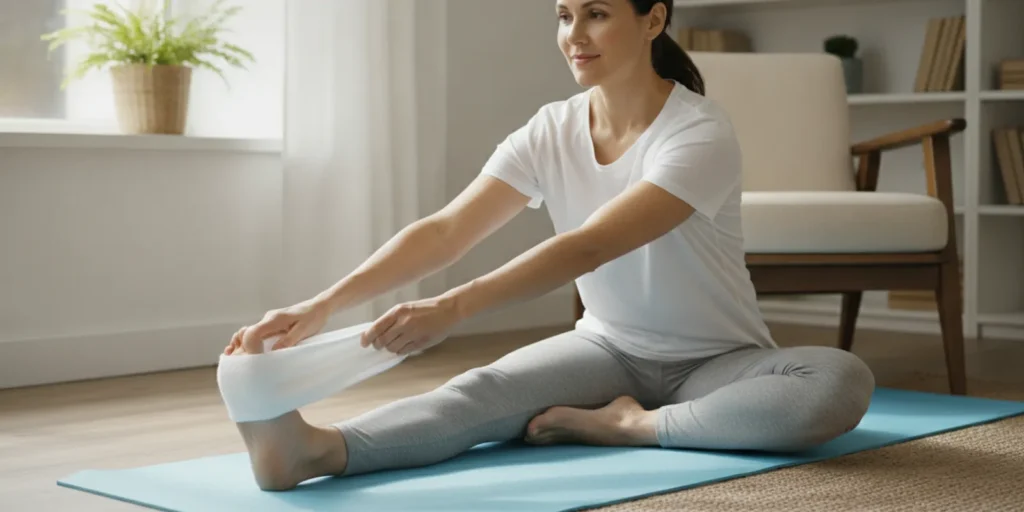
You can also sit with your leg extended and loop a towel around the ball of the foot. Hold both ends and gently draw the towel toward you while keeping the knee relaxed. Avoid yanking the towel or forcing the ankle into a painful position. If reaching your foot is difficult, do not strain your back or balance to complete the stretch.
Which calf stretches may complement foot stretching?
Calf flexibility can affect ankle movement, so some people include a calf stretch along with the plantar fascia stretch. A wall provides support and makes it easier to control your stance.
Standing calf stretch with the knee straight
Face a wall and place both hands on it. Step one foot back, keep that heel on the floor, and point the toes mostly forward. Bend the front knee and shift your weight toward the wall until you feel a mild stretch in the back calf. Keep your back heel down; do not bounce. Hold for 15 to 30 seconds, then ease out and switch sides.
Standing calf stretch with the knee slightly bent
Use the same supported position, but bend the back knee a little while keeping the heel down. This changes where you feel the stretch in the lower calf. Keep the movement small and comfortable. If the heel lifts or the foot twists, shorten your stance or stop.
For either version, steady breathing and a gentle pull are more useful than trying to reach a particular depth. A stretch should feel like mild tension, not a sharp jab, burning, tingling, or a feeling that the foot is being forced.
How often should you do plantar fasciitis stretches?
There is no single schedule that fits every person. A cautious starting point is a few gentle repetitions of each comfortable stretch once or twice a day. Some people find a brief stretch helpful before taking their first steps after rest; others may prefer to stretch when the foot is warm and relaxed. Do not treat a suggested schedule as a prescription, and do not keep increasing the duration or force just because symptoms have not changed immediately.
Pay attention to how the foot feels during the exercise and later that day. If symptoms settle or remain stable, continue only at a comfortable level. If pain rises, lingers more than usual, or is worse the next morning, reduce the range or frequency and seek advice if the change persists. Consistency matters more than an intense session. Stretching should not be used to push through pain or to justify continuing an activity that clearly aggravates your symptoms.
How can you make a simple, low-pressure routine?
Choose one comfortable foot stretch and one calf stretch rather than trying every variation at once. Use a stable chair or wall for support, and set aside a brief time when you are not rushing. A short routine that is easy to repeat can be more practical than a long session that leaves the foot sore. Keep the movements gentle and do not add extra repetitions simply because you have time.
For several days, you can note the time of day, which movement you tried, how the foot felt during it, and whether discomfort changed afterward. A simple record may help you recognize patterns to discuss with a clinician. It is not necessary to track every sensation or to test the foot repeatedly. If you notice that a particular stretch reliably increases symptoms, leave it out and seek advice rather than trying to force progress.
Consider the setting, too. Use a nonslip surface and a chair that will not slide. Keep a hand near a wall or counter when standing. If standing balance is difficult, use the seated variation or skip the stretch until you can get guidance. Avoid stretching when you are distracted, carrying something, or in a position where you might fall. These practical adjustments do not treat the cause of pain, but they can make a gentle movement safer to attempt.
If heel pain is part of a wider problem involving the ankle, knee, hip, or back, a clinician can help assess the whole picture. Miami Stem Cell provides information about pain management options and its frequently asked questions page; neither resource replaces an individual medical evaluation.
What common stretching mistakes should you avoid?
- Pulling into pain: A stronger stretch is not necessarily a better one. Ease off at the first sign of sharp or escalating discomfort.
- Bouncing: Repeated bouncing can make it harder to control the load. Hold a still, gentle position instead.
- Rushing the movement: Move into and out of each stretch slowly. Sudden pulls may provoke symptoms.
- Letting the heel lift during a wall stretch: Shorten your stance or reduce the forward lean so the heel stays comfortably grounded.
- Twisting the foot: Keep the foot pointed in a natural direction rather than rolling it inward or outward to chase a deeper stretch.
- Stretching through numbness or tingling: These sensations are not a normal target for a flexibility exercise. Stop and get medical guidance if they occur.
- Expecting stretching alone to solve every case: Pain may have another cause or need a broader assessment. Avoid self-diagnosing based only on where it hurts.
Footwear, activity levels, and other health factors may also matter. For example, repeatedly walking barefoot on a hard surface may feel uncomfortable for some people, but that observation does not establish the cause of heel pain. If you are unsure whether to modify activity or footwear, ask a qualified clinician for advice that fits your situation.
What if a stretch is difficult to do?
Do not force a position that you cannot reach comfortably. If crossing one ankle over the opposite thigh is difficult, sit with the leg supported in front of you and try the towel variation only if you can place it without straining. You can also skip the foot stretch. An exercise is not useful if getting into position creates back, hip, or knee pain, or if it makes you feel unsteady.
For a wall stretch, stand close enough to the wall to keep your balance and use a smaller step. Keep both hands supported and avoid leaning so far forward that your foot or ankle is pushed beyond a comfortable range. If you cannot keep the heel down without pain, do not force it. A seated option may be easier, or a clinician may suggest another way to assess mobility. People with reduced sensation, balance concerns, a recent injury, or other medical conditions should ask a qualified professional before beginning a new exercise routine.
What should you do after stretching?
Ease out of the position slowly and take a moment before standing. Notice whether the foot feels the same, more comfortable, or more irritated; avoid repeatedly pressing or pulling on it to check. If you feel well, return to usual activity at a sensible pace instead of immediately adding a strenuous workout to test the change. If you experience a lasting flare, pause the exercise and discuss it with a clinician.
Keep expectations realistic. A stretch may briefly change how tight the foot feels, but that feeling alone does not show that the underlying problem has resolved. Track only the practical details that can help guide a conversation: what you tried, whether it was tolerable, and whether ordinary walking is affected. This keeps exercise from becoming a cycle of constant testing.
How do the main stretching options compare?
| Option | How to do it | What to notice | When to stop or modify |
|---|---|---|---|
| Seated plantar fascia stretch | Gently draw toes toward the shin while seated, or use a towel around the ball of the foot. | Mild tension along the arch or sole. | Stop for sharp pain, increased symptoms, or difficulty holding the position without strain. |
| Wall calf stretch, knee straight | Step one foot back, keep the heel down, and lean forward slightly with hands supported. | A mild stretch in the back of the calf. | Shorten the stance if the heel lifts; stop for pain or a forced ankle position. |
| Wall calf stretch, knee bent | Use a supported wall stance and bend the back knee slightly while keeping the heel down. | A gentle stretch lower in the calf. | Reduce the bend or stop if the foot twists, heel lifts, or symptoms worsen. |
| No stretch / seek evaluation | Pause the exercise and arrange an assessment when symptoms are concerning or persistent. | Note what triggers the pain and whether walking is affected. | Seek prompt care for severe symptoms, a significant injury, or inability to bear weight. |
This table is a general comparison, not a personalized exercise plan. The best option may be none of these until the cause of pain is clearer.
When should you stop stretching and get evaluated?
Stop the exercise if you feel sharp pain, sudden worsening, burning, tingling, numbness, or a new sense of weakness. Do not keep stretching to test whether the sensation will pass. If the discomfort settles quickly after you stop, avoid repeating the same movement until you have considered whether the position or force was too much.
Arrange a clinical evaluation if heel pain is persistent, keeps returning, interferes with normal walking, or is not improving with sensible changes to activity. Seek prompt medical attention after a significant injury, if you cannot bear weight, or if there is marked swelling, redness, warmth, fever, or a wound. These signs can have causes other than plantar fascia irritation and should not be managed by stretching alone.
Before an appointment, it may help to note when the pain began, where it is located, what makes it better or worse, and which stretches or activities affect it. A clinician can examine the foot and decide whether further evaluation is needed. If you also have joint symptoms, pages about arthritis, knee pain, hip pain, and back pain offer related condition information, but they are not substitutes for care tailored to you.
What should you know about care options?
Stretching is one conservative self-care measure, not a complete treatment plan or a promise of recovery. A clinician may consider your history, examination, activity needs, and other possible causes before discussing options. Avoid choosing an invasive or regenerative procedure based only on an online exercise guide. Ask what is known about the proposed option, its uncertainties, potential risks, alternatives, and expected costs.
Miami Stem Cell describes its focus as “Non-Surgical Regenerative Treatments that target the root cause of pain and mobility limitations.” The clinic reports 8,500+ procedures, 17+ years of experience, and a 4.8-star Google rating. These statements do not predict an individual result. Its services are self-pay: treatments are out-of-pocket and not covered by insurance. Learn more about stem cell therapy or browse the patient education blog before discussing whether a consultation is appropriate for you.
Frequently Asked Questions
Can plantar fasciitis stretches make heel pain worse?
They can aggravate symptoms if the stretch is too forceful, the position is unsuitable, or the pain has another cause. Use a mild range and stop if pain increases, becomes sharp, or continues to worsen after the exercise.
Should I stretch before getting out of bed?
Some people choose a gentle seated foot stretch before standing after a period of rest. Keep the movement comfortable and supported. If it causes pain or you are uncertain about the symptoms, do not force it; ask a clinician what is appropriate.
How long should I hold a stretch?
A gentle hold of about 15 to 30 seconds is a common starting point for the examples in this guide. This is general information, not an individualized prescription. Shorten the hold or stop if symptoms increase.
Can stretching confirm that I have plantar fasciitis?
No. A response to stretching cannot confirm the cause of heel pain. A clinician can review your symptoms and examine you to determine whether evaluation or another approach is needed.
Use gentle movement as one small part of a careful plan, and get professional guidance when heel pain persists, limits walking, or raises concern.